|
Colour in Context
Research group Computer Vision Center |
 |
Object Recoloring based on Intrinsic Image Estimation:
Demo code for recoloring in matlab is available here:
Watch the updated video describing our work here:
(please right click on the link and choose "save as...")
Here's the high resolution poster presented in ICCV 2011:
And the full resolution paper published in ICCV 2011 for further reference:
Shida Beigpour, Joost van de Weijer, Object Recoloring based on Intrinsic Image Estimation, Proc. ICCV, Barcelona, Spain, 2011.
Abstract.
Object recoloring is one of the most popular photoediting tasks. The problem of object recoloring is highly under-constrained, and existing recoloring methods limit their application to objects lit by a white illuminant. Application of these methods to real-world scenes lit by colored illuminants, multiple illuminants, or interreflections, results in unrealistic recoloring of objects.
In this paper, we focus on the recoloring of singlecolored objects presegmented from their background. The single-color constraint allows us to fit a more comprehensive physical model to the object. We show that this permits us to perform realistic recoloring of objects lit by colored lights, and multiple illuminants. Moreover, the model allows for more realistic scene relighting. Recoloring results on images captured by uncalibrated cameras demonstrate that the proposed framework obtains realistic recoloring for complex natural images. Furthermore we use the model to transfer color between objects and show that the results are more realistic than existing color transfer methods.
Moreover, the model allows for more realistic scene relighting. Recoloring results on images captured by uncalibrated cameras demonstrate that the proposed framework obtains realistic recoloring for complex natural images. Furthermore we use the model to transfer color between objects and show that the results are more realistic than existing color transfer methods. Below is an example of the performance of the method as well as a video describing the paper.
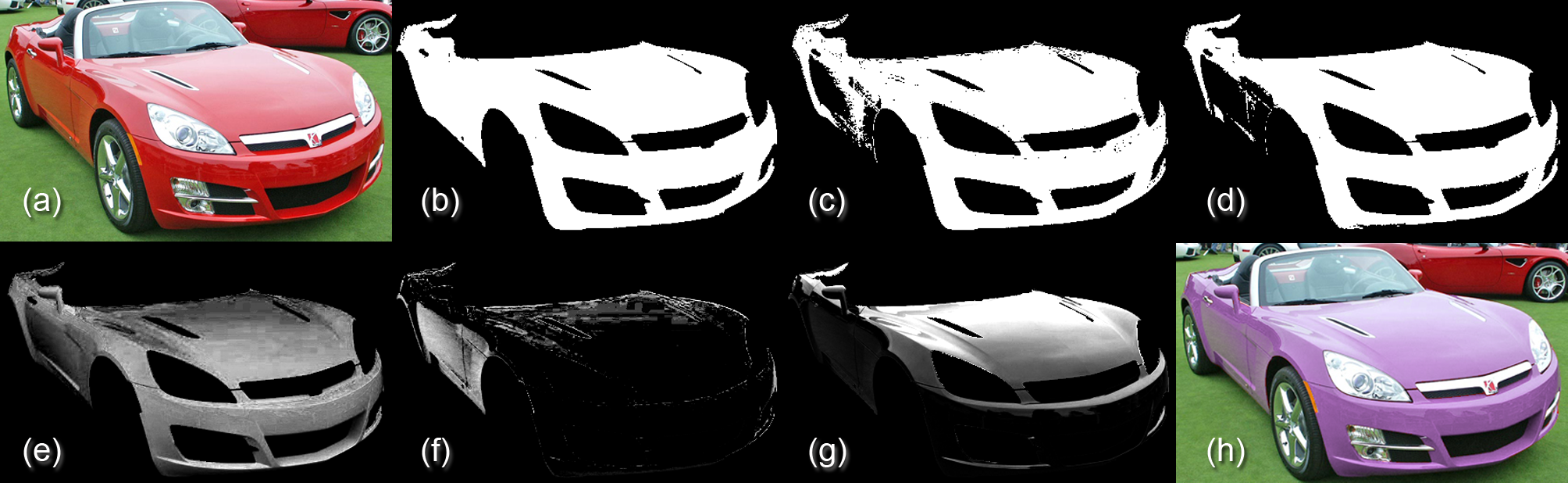
Above is an example of multi-illuminant object recoloring: (a) Original image; (b) Object mask as the initial mask for the primary illuminant; (c) The Mask after 1st iteration; (d) The Mask at 3rd (final) iteration; (e) estimated body (diffuse) reflectance cause by the primary illuminant; (f) estimated body (diffuse) reflectance cause by the secondary illuminant (the interreflection area has been correctly detected); (g) estimated specular reflectance; (h) An example recoloring (the green interreflection is preserved).
[1] Shida Beigpour, Joost van de Weijer, Object Recoloring based on Intrinsic Image Estimation, Proc. ICCV, Barcelona, Spain, 2011. - Suplementary Video (please right click on the link and choose "save as...")- Poster
|
||
|
Contact
webmaster | Last updated: Monday 11
May 2009

|